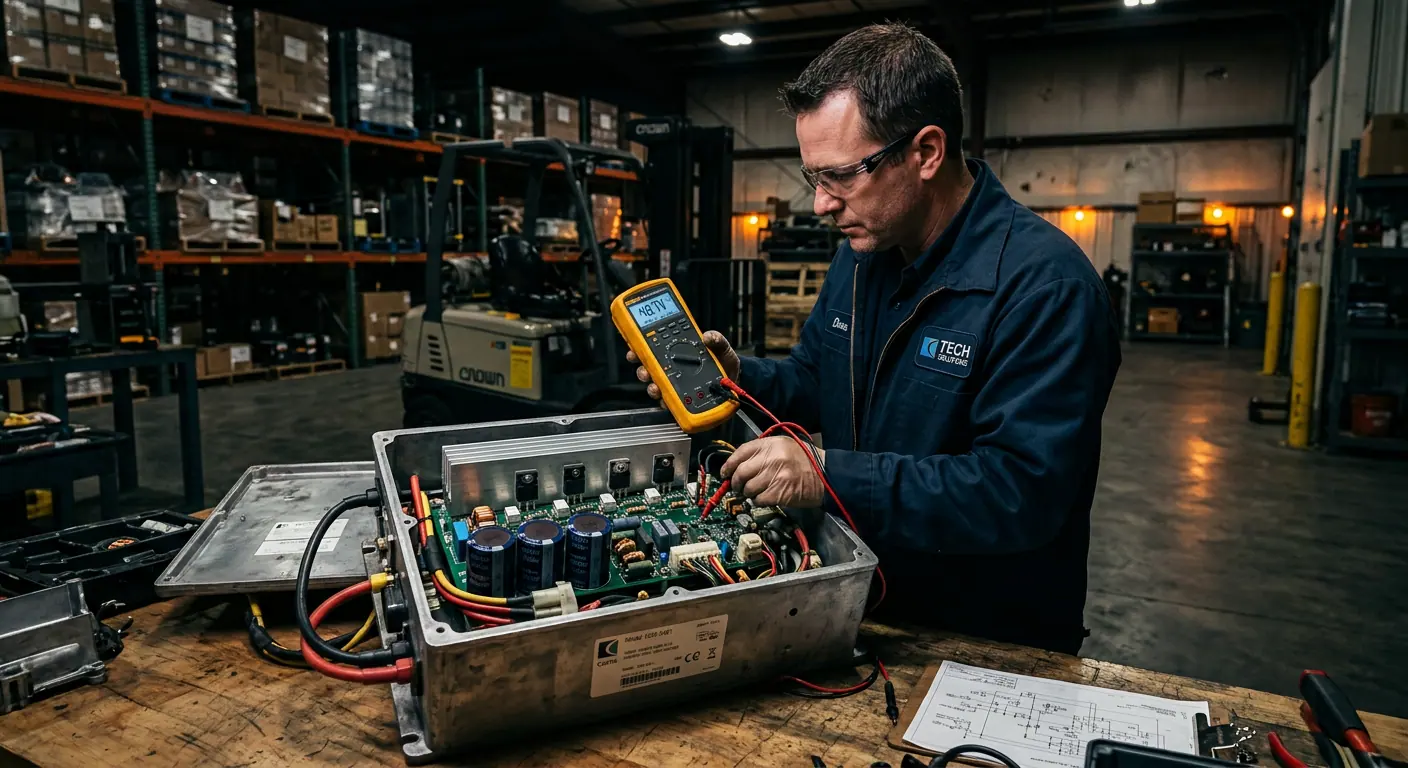
Li-ion Forklift Charger and Rectifier Repair – Nationwide in Poland
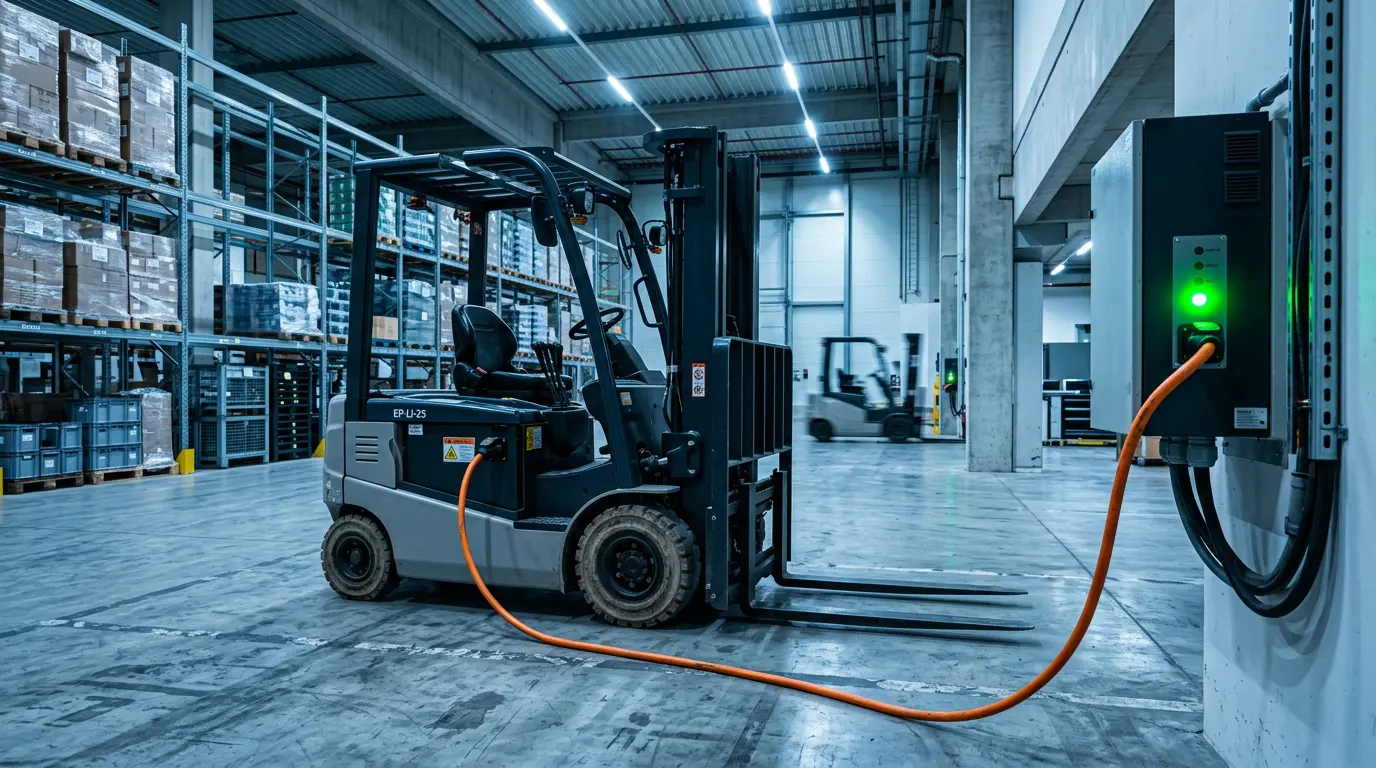
A lithium-ion forklift charger is not an ordinary battery rectifier. It is a power-electronics unit that talks to the Li-ion pack's BMS, sets voltage and current in real time and stops charging before the cells are damaged. When it fails, the truck stands still and the warehouse loses throughput. We repair chargers and rectifiers for Li-ion batteries from all popular makers of forklifts, pallet trucks, lifts and work platforms – serving companies across Poland by courier and on site in Silesia. This guide collects technical data, typical faults, a list of brands and a description of how a repair works at our shop.
How a Li-ion charger differs from a lead-acid battery rectifier
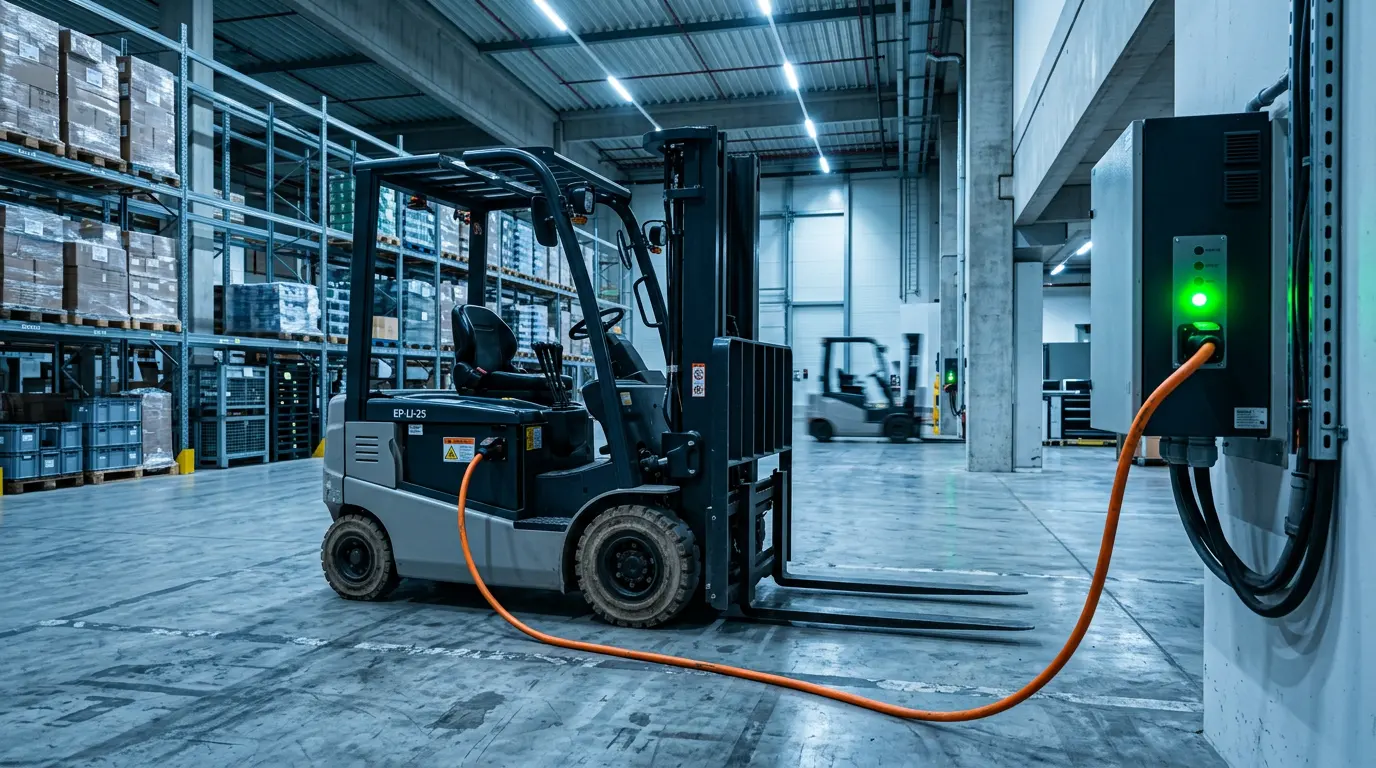
A classic traction rectifier follows an IU or IUI curve and needs no information from the battery. A Li-ion charger is controlled by the BMS: the pack tells the charger what voltage and current it needs and the charger follows. If communication is lost, the charger will by design not start – that is a safety feature, not a fault.
| Feature | Lead-acid (rectifier) | Li-ion (charger with communication) |
|---|---|---|
| Control | IU / IUI curve inside the charger | Commands from the BMS over CAN or another bus |
| Charge time | 8–10 h plus cooling | 1–3 h, opportunity charging possible |
| Efficiency | approx. 80–85 % | up to 95 % and above |
| Protection | Depends on charger | BMS + charger (overvoltage, temperature, balancing) |
| Water topping | Yes (flooded cells) | No |
| Typical fault | Thyristors, transformer, fuses | IGBT/MOSFET modules, PFC, CAN communication, logic supply |
In practice a Li-ion charger must be diagnosed on two tracks: the power stage (supply, rectification, high-frequency inverter) and the communication stage. A “broken charger” often turns out to be healthy while the CAN cable, connector or BMS board is at fault – and vice versa.
Architecture of a high-frequency charger for Li-ion trucks
Modern forklift chargers are switch-mode units running at tens of kHz, from a few hundred watts (pallet trucks) up to tens of kilowatts (large counterbalance trucks and platforms). The structure is similar across manufacturers:
| Block | Function | Typical failures |
|---|---|---|
| EMC input filter and rectifier | Noise suppression, mains rectification | Blown fuses, failed bridges, varistors after surges |
| PFC stage | Power-factor correction, DC-link regulation | Transistors/IGBTs, diodes, electrolytic capacitors |
| High-frequency inverter | DC–AC conversion for the switch-mode transformer | IGBT/MOSFET modules, gate drivers, snubbers |
| Transformer and output rectifier | Galvanic isolation and voltage matching | Overheating, failed SiC/Schottky diodes |
| Digital controller (DSP/MCU) | Charging algorithm, U/I/T measurement | Failed logic supply, memory, current sensing |
| Communication interface | CAN / RS-485 / signal contact to BMS | Failed transceiver, short circuit, bad cable |
| Cooling | Fan, heatsink, temperature sensors | Blocked fan, dust, dried thermal paste |
Forklift, charger and Li-ion pack brands we service
We work on chargers intended for trucks and warehouse machines from many manufacturers. The scope of repair depends on the model, available documentation and condition of the unit – before accepting a job we always confirm whether we will repair that particular model.
Popular forklift manufacturers
- Linde Material Handling
- STILL
- Jungheinrich
- Toyota Material Handling
- BT
- Hyster
- Yale
- Crown
- Mitsubishi / Cat Lift Trucks
- Komatsu
- Nissan
- Clark
- Doosan
- Hangcha
- Heli
- EP Equipment
- Noblelift
- Baoli
- Manitou
- Combilift
- Rocla
- Atlet
- Cesab
- Still / Fenwick
Traction charger and rectifier manufacturers
- Fronius
- Benning
- EnerSys / Hawker
- Zivan
- SPE
- Ratio Electric
- Hoppecke
- Exide
- Triathlon
- Delta-Q
- Midac
- Ecoo
- Jungheinrich
- STILL
- Linde
- Toyota
- BSLBATT
- Flux Power
Li-ion systems and battery manufacturers for trucks
- Linde Li-ION
- Jungheinrich Li-ION
- Toyota Li-ion
- EnerSys NexSys iON
- Hoppecke
- Triathlon
- BSLBATT
- Flux Power
- Exide
- Midac
- Samsung SDI
- CATL
- BYD
- LG Energy Solution
All brand names are trademarks of their respective owners and are used only to identify the equipment we service. We are not an authorised service partner of the manufacturers.
Typical voltages and charger classes for Li-ion trucks
The table shows indicative classes we meet most often. We always read the exact parameters from the nameplate.
| Application | Nominal pack voltage | Indicative charge current | Charger supply |
|---|---|---|---|
| Pallet trucks, powered hand trucks | 24 V | 20–80 A | 1-phase 230 V |
| Stackers, reach and high-bay trucks | 24 / 48 V | 50–150 A | 1-phase 230 V or 3-phase 400 V |
| Counterbalance trucks 1.5–3.5 t | 48 / 80 V | 100–300 A | 3-phase 400 V |
| Large counterbalance, container handlers, platforms | 80 V and above | 200–400 A | 3-phase 400 V |
Most common Li-ion charger faults – symptoms and causes
Below are the symptoms customers report most often, with likely causes and what we do in the workshop.
| Symptom | Probable cause | What we do |
|---|---|---|
| Charger will not switch on, display dark | Failed auxiliary supply, fuse, input filter | Measure supply rails, replace failed parts, test after repair |
| Breaker trips in the distribution board | Short in input bridge or PFC, failed IGBT | Semiconductor tests, replace power modules and drivers |
| Lights up but does not charge (no current) | No BMS communication, failed inverter, stuck contactor | CAN test, check cables and connectors, power-stage test |
| Communication error / BMS not detected | Failed CAN transceiver, broken wire, bad connector | Bus measurement, replace transceiver, repair cable |
| Charging stops after a few minutes | Overheating, dusty heatsink, worn fan | Cleaning, fan and paste replacement, temperature sensor check |
| Charge voltage or current too low | Aged capacitors, current-measurement error, calibration drift | Replace capacitors, recalibrate measurement paths |
| Loud operation, burnt smell | Failed capacitors or resistors, shorted turns | Detailed inspection, replace parts, load test |
| Errors after lightning or surge | Failed varistors, bridge, logic supply | Full diagnostics of power and control boards |
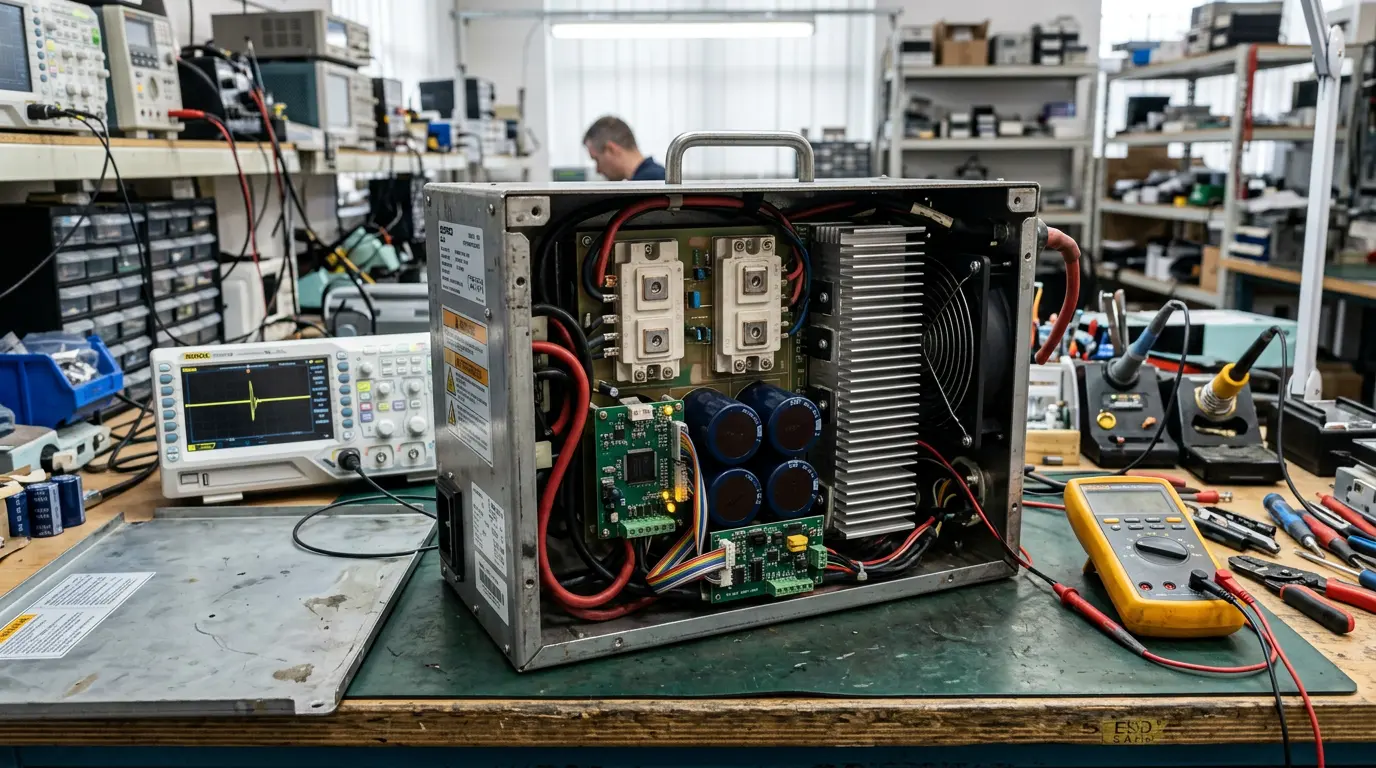
How a Li-ion charger repair works step by step
Every unit goes through the same repeatable process, so we know exactly what was repaired and can confirm it with a test.
- Intake and interview – we read the nameplate, error code, fault history and which Li-ion pack the charger works with.
- Inspection and unpowered measurements – visual check, tests of semiconductors, capacitors and fuses.
- Communication diagnostics – CAN bus check, 120 Ω termination, transceiver supply voltages.
- Component-level repair – replacing failed IGBT/MOSFET modules, drivers, capacitors, fans and connectors.
- Staged power-up – supply through a variable autotransformer with current limiting, checking intermediate voltages.
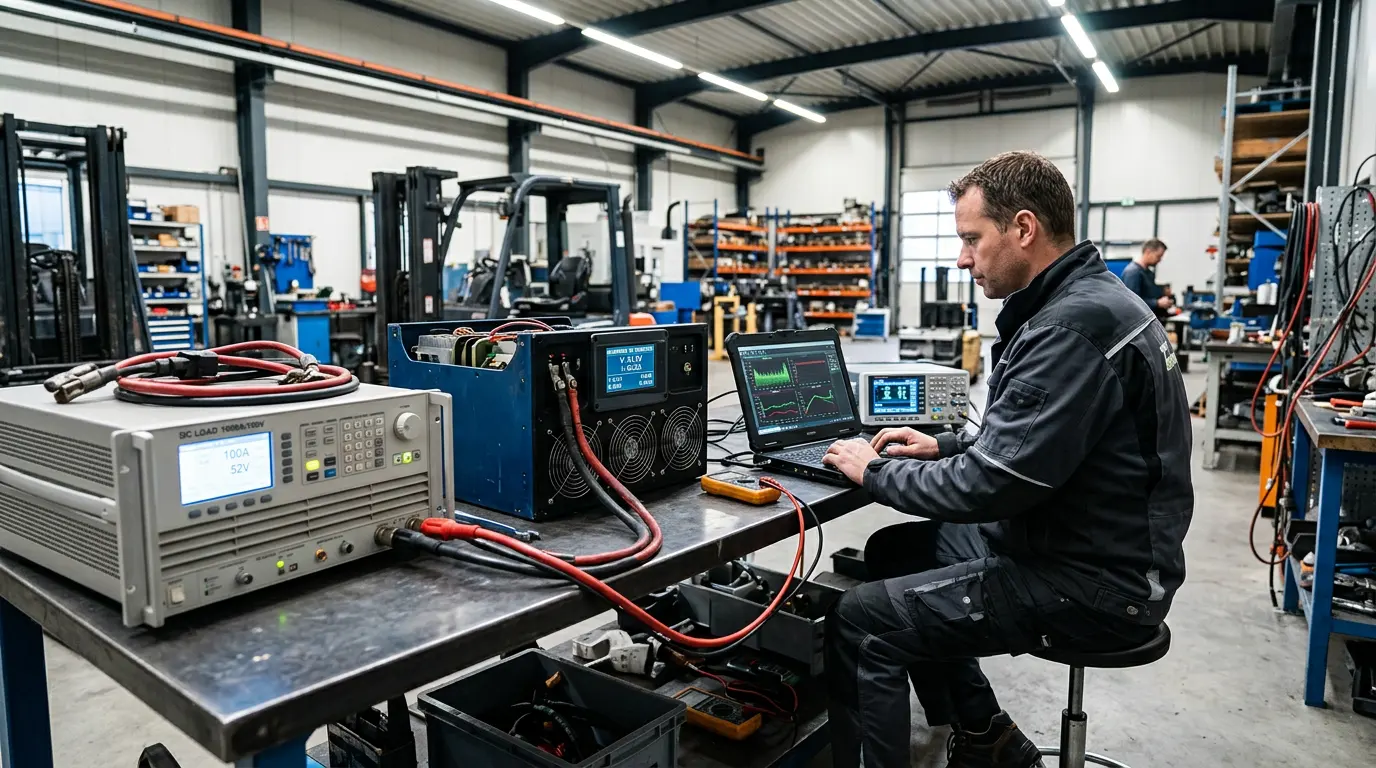
- Load test – operation on an electronic load or BMS simulator over the full current range.
- Report and handover – description of the work done and operating recommendations.
Charger–BMS communication – CAN, protocols and compatibility
The most frequent reason a healthy charger does not charge a Li-ion pack is missing or mismatched communication. Each manufacturer uses its own frames and identifiers, so the charger must be paired with a specific BMS type.
| Interface | Use | Typical problems |
|---|---|---|
| CAN 2.0B (500 kbit/s or 250 kbit/s) | Most common charger–BMS link | Missing 120 Ω termination, swapped CAN-H/CAN-L, interference |
| CANopen / SAE J1939 | Packs and chargers in industrial machines | Wrong node address, mismatched speed |
| RS-485 / Modbus RTU | Older or simpler systems, supervisory link | Wrong serial settings, no shielding |
| Signal contact (enable / alarm) | Simple systems with a BMS relay | Oxidised contacts, broken signal wire |
| Bluetooth / Wi-Fi (diagnostics) | Viewing pack and charger status | Firmware updates, version mismatch |
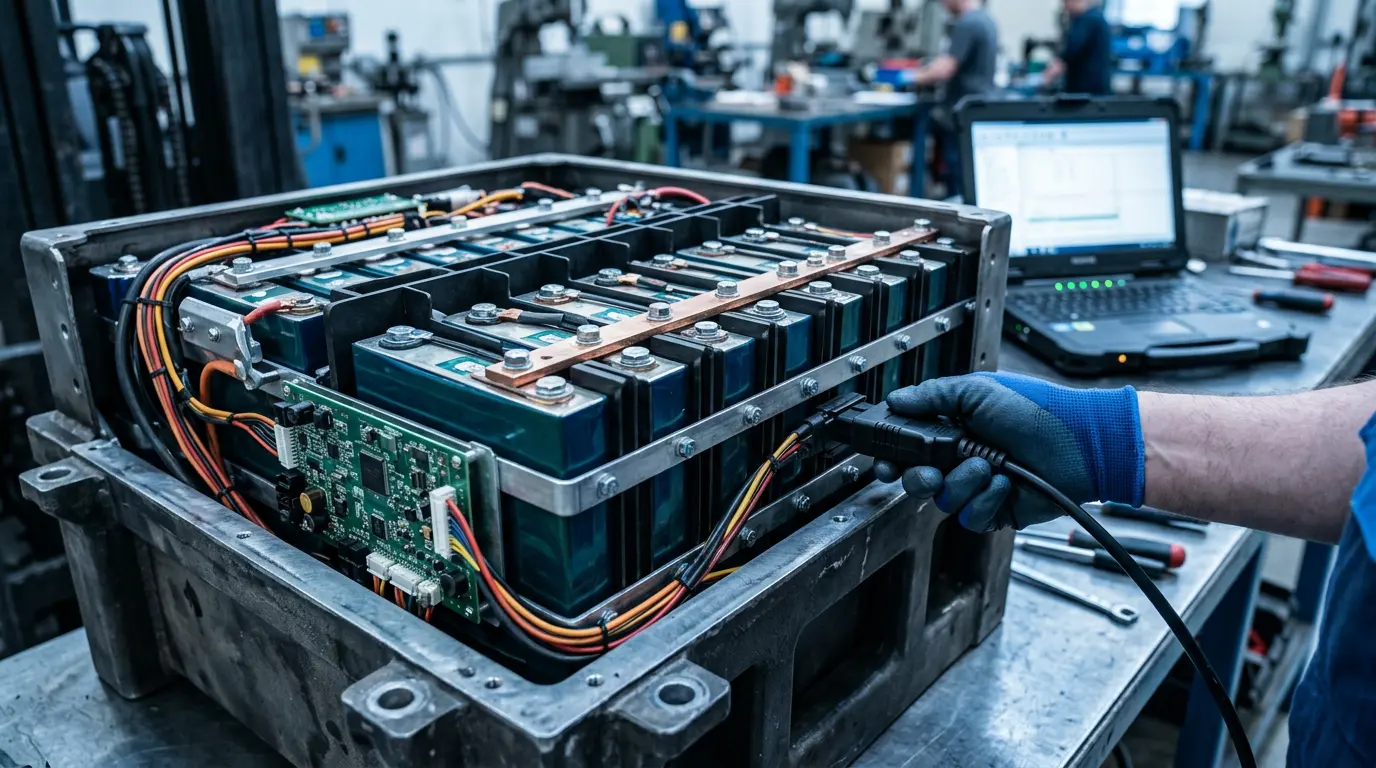
So before repairing a charger we also check the communication cable, connectors and, where possible, the BMS read-out. Sometimes after the repair it is enough to match the charger profile to the pack – the profile and end-of-charge voltage follow the cell manufacturer's data.
What we repair in chargers and Li-ion systems
We specialise in electronics. Our scope includes:
- traction chargers and rectifiers for Li-ion forklifts,
- chargers for pallet trucks, lifts and work platforms,
- high-frequency and older thyristor chargers,
- power boards, PFC, high-frequency inverters, auxiliary supplies,
- CAN communication cards and BMS interfaces,
- BMS boards and pack-management electronics (diagnostics and repair after consultation),
- opportunity-charging modules and multi-bay stations,
- cooling systems, fans, protections and contactors.
What we do not do
We do not open cell modules or perform mechanical pack repairs that would require work on lithium cells – for safety reasons that belongs to the pack manufacturer. If the problem is cell wear, we will say so plainly after diagnostics.
Post-repair testing – on the bench, not on the warehouse floor
A repaired charger is checked on an electronic load or BMS simulator, logging voltages, currents and temperatures over time. Only stable operation across the full range allows release. That way you do not discover the fault a week later on the truck.
How to send a charger for repair from anywhere in Poland
We serve companies nationwide – chargers are received by courier or freight, and around Silesia pickup or on-site service is possible. To speed up diagnosis, prepare:
- a photo of the nameplate of the charger and the Li-ion pack,
- a description of symptoms, error codes or a photo of the display,
- truck brand and model and battery type,
- the communication and power cables the unit works with,
- safe packaging protecting against impact and moisture.
Service area – all of Poland
We repair Li-ion forklift chargers and rectifiers for logistics firms, warehouses, factories and distribution centres across the country, including cities such as:
- Warszawa
- Kraków
- Wrocław
- Poznań
- Gdańsk
- Gdynia
- Łódź
- Szczecin
- Lublin
- Bydgoszcz
- Toruń
- Białystok
- Katowice
- Rzeszów
- Kielce
- Olsztyn
- Opole
- Zielona Góra
- Gorzów Wielkopolski
- Radom
- Płock
- Częstochowa
- Bielsko-Biała
- Gliwice
Locally, around Gliwice, Knurów, Zabrze, Rybnik, Katowice and the surrounding area, we come to your site. We work on business days, Mon–Fri, 8:00–16:00. Individual quote after diagnostics.
Safety and operation of Li-ion chargers
To reduce failures: do not charge packs in unventilated rooms, keep the heatsink and vents clean, avoid undersized extension cables, never connect the charger without overcurrent and residual-current protection, and inspect cables and connectors regularly. If you smell burning, see smoke or notice a deformed housing, disconnect power immediately and do not try to restart the unit.
Call or write – Li-ion charger for repair
Charger not charging your truck? Call: +48 504 511 170. contact form · our services · forklift controller repair · connecting devices to SCADA. We reply on business days between 8:00 and 16:00.
Frequently asked questions
- Do you repair Li-ion forklift chargers from all of Poland?
- Yes. We receive chargers by courier or freight from across the country, and around Silesia pickup or on-site service is possible. We work on business days, Mon–Fri, 8:00–16:00.
- Why does a Li-ion charger light up but not charge the truck?
- Most often BMS communication is missing (CAN cable, connector, transceiver) or the power stage – an IGBT/MOSFET module or the PFC – has failed. A Li-ion charger by design will not charge without valid communication with the pack.
- Which forklift and charger brands do you service?
- We work on equipment from Linde, STILL, Jungheinrich, Toyota, Hyster, Yale, Crown, Mitsubishi, Komatsu, Doosan, Hangcha, Heli, EP Equipment and others, and chargers from Fronius, Benning, EnerSys/Hawker, Zivan, SPE, Hoppecke and more. We confirm before accepting whether we will repair a given model.
- Do you repair the Li-ion batteries themselves?
- We specialise in electronics: chargers, power boards, CAN communication and BMS boards (after consultation). We do not open lithium cell modules – that is a safety matter for the pack manufacturer.
- How should I prepare a charger for shipping?
- Photograph the nameplates of the charger and pack, describe the symptoms or error codes, include the communication and power cables and pack the unit to protect it from impact and moisture.
- How long does a charger repair take?
- It depends on the fault and parts availability. After diagnostics we tell you the scope of work and expected lead time. Quotes are individual.
- Can a lead-acid battery charger be used for Li-ion?
- No. A Li-ion pack needs a charger with the right profile and, usually, BMS communication. Using the wrong charger risks damaging the pack and creates a safety hazard.
- How can I reduce the risk of charger failure?
- Keep the heatsink and vents clean, ensure ventilation, use overcurrent and residual-current protection, avoid thin extension cables and inspect cables and connectors regularly.
Have a similar problem?
Call us, describe the fault – we'll tell you if we can help.
Call: +48 504 511 170